
Why Residential Water Well Installation in Texas Is More Complicated Than You Think
Most people assume that residential water well installation in Texas is as simple as picking a spot in the yard, drilling a hole, and watching clean water flow. We wish it were that easy. After years of water well installation projects across the North Houston area, we at B-E Waterwell Services LLC have seen firsthand how much goes on beneath the surface, both literally and figuratively. From navigating groundwater regulations to selecting the right pump systems, there is a world of detail that separates a well that lasts decades from one that causes headaches within months.
If you are considering a water well installation for your home, ranch, or commercial property in Magnolia TX or the surrounding communities, this guide will walk you through the things most people never hear about until it is too late. We are pulling back the curtain on everything from aquifers and soil types to well casing and screen selection, water quality testing, and long-term maintenance. Whether you need a domestic well, irrigation well drilling for your acreage, or an emergency water well service solution, this is the article we wish every property owner would read before breaking ground.
Understanding What Lies Beneath: Aquifers, Groundwater Conditions, and Why They Matter in Magnolia TX
The Geology Under Your Property Determines Everything
Before we ever bring a drilling rig to your property, we spend time evaluating the groundwater conditions specific to your location. In the Magnolia TX water well installation market, the Gulf Coast Aquifer System is the primary source of groundwater. This aquifer stretches across much of Southeast Texas, but its depth, yield, and water quality can vary dramatically from one property to the next, even across a single neighborhood.
Soil types play a crucial role in how we approach water well drilling. The North Houston area features a mix of clay, sand, and sandy loam. Clay-heavy soils can make drilling more challenging and affect the rate at which water recharges around the well. Sandy formations, on the other hand, tend to produce better yields but require careful well casing and screen design to keep sand out of your water.
We always assess the static water level before finalizing our water system design. The static water level tells us how deep the water sits when the well is at rest, and it directly influences our pump selection and pressure tank sizing. During the drilling process, we also measure the pumping water level, which is how far the water drops when the pump is actively running. The difference between these two measurements helps us calculate well yield, typically measured in gallons per minute (GPM), and ensures the pump systems we install will not overwork themselves trying to deliver water that is not there.
Why Local Knowledge Makes or Breaks Your Water Well Installation
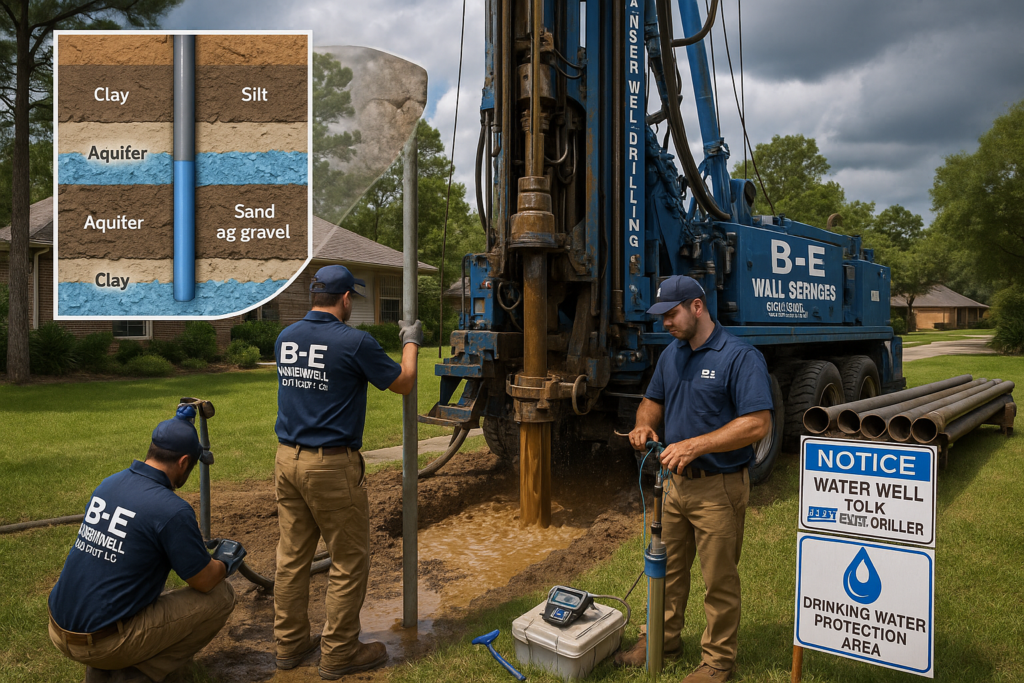
We have completed Magnolia TX water well installation projects where the neighbor’s well was 200 feet deep and ours needed to go past 350 feet to hit a productive zone. That is not unusual. Aquifers are not uniform sheets of water. They consist of layers of water-bearing sand and gravel separated by clay and silt. Without a thorough understanding of local hydrogeology, a driller can miss productive zones entirely or set the well casing and screen at the wrong depth, leading to poor yield or contamination issues.
Our team serves Tomball TX, The Woodlands TX, Conroe TX, and the broader North Houston area. Each of these communities sits on slightly different portions of the Gulf Coast Aquifer, and we have built a detailed understanding of what to expect in each locale. This knowledge directly translates to more accurate depth estimates, better pricing, and wells that deliver a reliable water supply for decades.
The Water Well Drilling and Installation Process Nobody Explains in Detail
Step One: Permits, Regulations, and Legal Requirements
Here is something that catches many property owners off guard: water well drilling in Texas is heavily regulated, and for good reason. The Texas Department of Licensing and Regulation (TDLR) requires that all water well drillers hold valid licenses and that every well meets specific construction standards. The Texas Commission on Environmental Quality (TCEQ) oversees groundwater regulations that protect both your water and the broader aquifer from contamination.
Before any water well installation begins, we handle the permitting process. This includes:
– Filing the required well reports with TDLR.
– Ensuring the well location meets minimum setback distances from septic systems, property lines, and potential contamination sources as outlined by TCEQ.
– Verifying compliance with any local groundwater conservation district rules that may apply in your area.
Skipping or mishandling these steps can result in fines, forced well abandonment, or worse, a contaminated water supply. We have seen cases where property owners hired unlicensed drillers and ended up with wells that did not meet code, requiring costly well repair and rehabilitation or complete decommissioning.
Step Two: Drilling, Casing, and Completing the Well
Once permits are secured, we mobilize our drilling rig to the site. Modern water well drilling uses rotary drilling equipment that can penetrate hundreds of feet of rock, clay, and sand with precision. The type of drilling rig we use depends on the anticipated depth, the soil types we expect to encounter, and whether the project is a residential domestic well or a larger irrigation well drilling job for farm and ranch water wells.
As we drill, we install well casing, a steel or PVC pipe that lines the borehole to prevent collapse and protect against surface contamination. The well screen is placed at the depth where water-bearing formations are located, allowing groundwater to flow into the well while keeping sand and sediment out. Proper well casing and screen installation is one of the most critical steps in the entire process. A poorly cased well can allow bacteria, agricultural runoff, or other contaminants to reach your water supply.
After the casing is set, we develop the well by pumping it at high rates to clear fine sediment from around the screen. During this phase, we conduct a yield test to determine the well’s production capacity in gallons per minute (GPM). This data drives every decision that follows, from pump sizing to pressure tank selection.
Step Three: Well Pump Installation and System Design
With the well drilled and tested, we move into well pump installation. For most residential water well installation in Texas projects, we recommend submersible pumps. Submersible pumps are installed deep inside the well casing, directly in the water. They are quieter, more efficient, and less prone to priming issues than above-ground jet pumps. For properties where power outages are a concern, we also offer hand pump systems as a manual backup.
Our water system design process considers:
– The well’s yield in GPM and the pumping water level under load.
– The number of fixtures, bathrooms, and irrigation systems the well needs to support.
– The distance from the well to the home or point of use.
– The appropriate pressure tank size to maintain consistent pressure and protect the pump from short cycling.
A pressure tank acts as a buffer between the pump and your plumbing. When sized correctly, it reduces the number of times the pump cycles on and off, extending the life of the motor and delivering steady pressure at every faucet. We see too many installations where the pressure tank is undersized, leading to premature pump failure and inconsistent water pressure.
For residential and commercial properties that depend on uninterrupted water, we also install backup systems. Our emergency backup solution options include generator prep kits that allow the well pump to operate during extended power outages. In rural areas around Magnolia TX, Tomball TX, and Conroe TX, where storms can knock out power for days, generator prep kits are not a luxury; they are a necessity for maintaining a reliable water supply.
After the Drill: Water Quality Testing, Inspections, and Long-Term Maintenance
Water Quality Testing Is Not Optional
Once your water well installation is complete and the pump systems are running, we perform comprehensive water quality testing. This is a step that some installers skip or rush through, but we consider it essential. We test for:
– Coliform bacteria and E. coli, which indicate potential contamination from surface water or septic systems.
– Iron and manganese, which are common in Gulf Coast Aquifer groundwater and can stain fixtures and affect taste.
– Hardness, pH, and total dissolved solids, which influence whether you need additional treatment equipment.
– Nitrates, which can pose health risks especially for infants and are sometimes found in agricultural areas.
If any parameters fall outside safe or desirable ranges, we recommend and install treatment solutions tailored to your specific water chemistry. Clean water is the entire point of this investment, and we refuse to hand over a system without confirming the water meets our standards.
Well Inspection and Maintenance: Protecting Your Investment for Decades
A new water well installation is a significant investment, and like any major system on your property, it requires ongoing care. We recommend a well maintenance schedule that includes:
– Annual well inspection to check the wellhead, casing condition, and pump performance.
– Water quality testing every one to two years, or immediately if you notice changes in taste, color, or odor.
– Pressure tank inspection to verify air charge and check for waterlogging.
– Pump performance testing to ensure the well yield remains consistent and the submersible pumps are operating within design parameters.
Our well repair and rehabilitation services address issues like declining well yield, pump failure, casing corrosion, or bacterial contamination. In many cases, a well that seems to be failing can be restored to full production with professional rehabilitation rather than requiring a completely new well.
We also handle well abandonment and decommissioning for old, unused, or damaged wells. Texas groundwater regulations enforced by TCEQ and TDLR require that abandoned wells be properly sealed to prevent them from becoming conduits for contamination into the aquifer. If you have an old well on your property that is no longer in service, it is not something to ignore. Improperly abandoned wells are environmental hazards and potential legal liabilities.
Choosing the Right Partner for Residential Water Well Installation in Texas
What Sets Farm, Ranch, and Residential Projects Apart
Not every water well installation company understands the differences between a domestic household well, an irrigation well drilling project for a large property, and farm and ranch water wells designed to support livestock and ranch water needs. Each application requires different well depths, pump systems, water system design approaches, and sometimes different permitting pathways.
For irrigation systems, we design wells that can sustain high-volume pumping over extended periods without depleting the local aquifer or damaging the pump. For livestock and ranch water needs, we factor in seasonal demand variations and often incorporate backup systems to ensure animals always have access to water. For residential and commercial properties, we prioritize consistent pressure, water quality, and system longevity.
We proudly serve the entire North Houston area, including Magnolia TX, Tomball TX, The Woodlands TX, and Conroe TX. Whether your project is a straightforward residential well on a half-acre lot or a complex irrigation and livestock system on a working ranch, our approach is the same: thorough site evaluation, transparent communication, and installation that meets or exceeds every applicable standard.
Emergency Water Well Service When You Cannot Wait
Water emergencies do not follow a schedule. When your pump fails on a holiday weekend, your well runs dry during a drought, or a storm damages your wellhead, you need emergency water well service from a team that can respond quickly. We offer emergency water well service because we understand that a home or ranch without water is not just an inconvenience. It is a crisis.
Our emergency response includes rapid diagnosis, temporary water solutions when needed, and fast-tracked well repair and rehabilitation or well pump installation to get your reliable water supply restored.
Your Next Step Toward a Reliable Water Supply
Installing a water well is one of the best decisions you can make for your property, but only if it is done right. From understanding the aquifers and groundwater conditions beneath your land to selecting the right submersible pumps, pressure tank, and backup systems, every detail matters. Water well drilling is not a weekend DIY project. It is a technical process governed by groundwater regulations and requiring specialized drilling equipment, licensed expertise, and ongoing commitment to well maintenance.
We have built our reputation across Magnolia TX, the North Houston area, and beyond by treating every water well installation as if it were on our own property. We handle the permits, the drilling, the well pump installation, the water quality testing, and the long-term maintenance so you can simply enjoy clean, dependable water.
If you are ready to explore residential water well installation in Texas for your home, ranch, or commercial property, we would love to talk. Reach out to our team at B-E Waterwell Services to schedule a consultation. Let us show you why the details nobody talks about are exactly the details we have built our business around.